10 admin jobs every holiday rental owner can automate
Running one to ten short-stay properties looks like a side income until the messages start. Enquiries at odd hours, the same check-in details typed out again, a cleaner to chase after every checkout. None of that needs to be your evening job. Here are ten admin jobs we see holiday rental owners doing by hand, and what automating each one looks like.
The admin behind a calm-looking listing
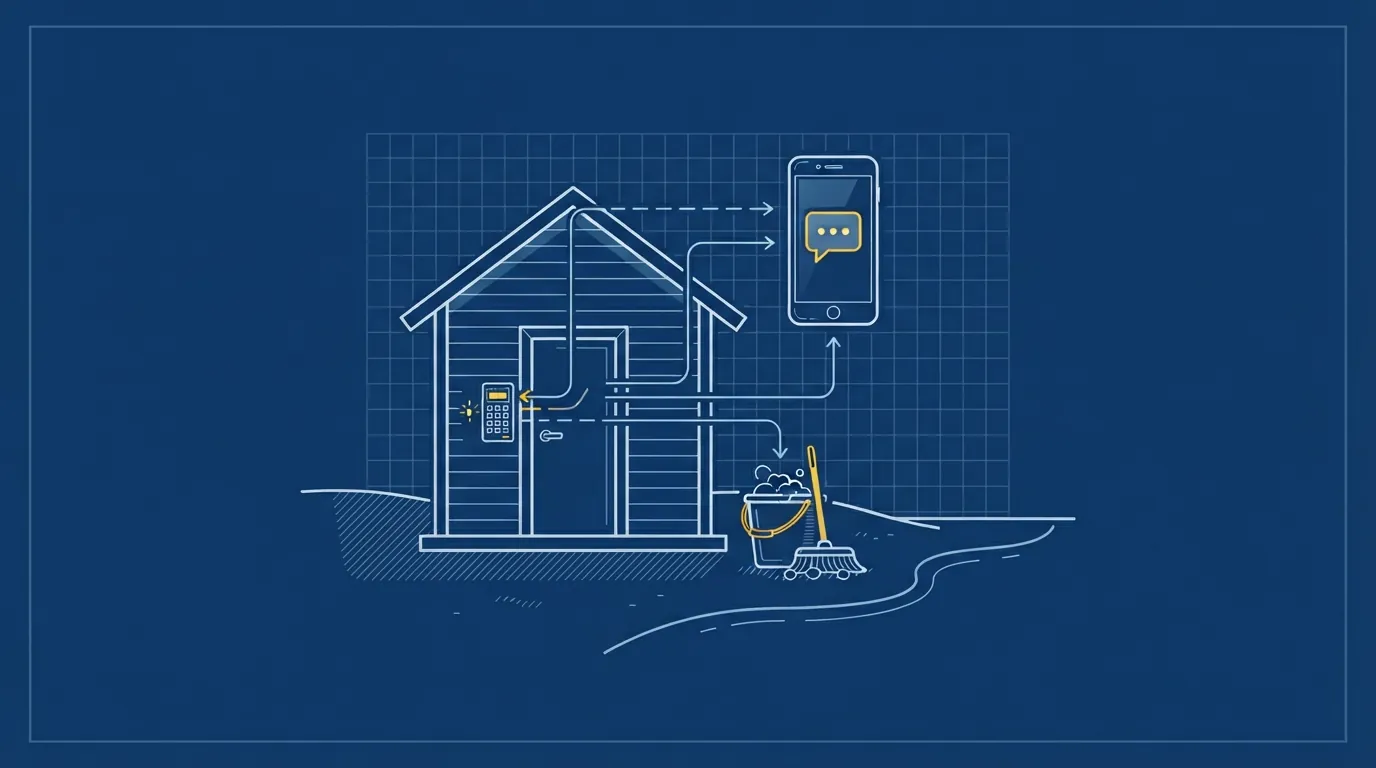
A good listing makes the stay look effortless, but behind it sits a small production line: someone answering the enquiry, chasing the deposit, writing the door code into a message at 11pm, finding a cleaner, checking the booking turned into a review. On one property that is manageable. On three to ten, it is a second job that pays you in messages, not money.
Below are ten of those jobs, and what automating each one looks like in practice. Most owners start with the one that eats the most evenings and add the rest as they go.
The 10 jobs, and what automating each one looks like
- Answering enquiries. A question about dates or pets that lands at 9pm often sits until morning, by which time the guest has messaged the next listing too. Instant enquiry replies acknowledge it the moment it arrives, so the guest knows you have seen it before they go looking elsewhere.
- Checking availability and taking the booking. Flicking between a calendar, a spreadsheet and a text thread to confirm a date is free is where double bookings start. A direct booking site shows real availability and takes the booking and a deposit at the time, so you are not confirming a date that is already gone.
- Sending the check-in guide. The door code, the wifi password, where to park, the bin night, typed out fresh for every guest, is a job in itself. An automated pre-arrival message sends all of it the day before, in the same order every time, so nothing gets left out at 6pm on a Friday.
- Pre-arrival and checkout reminders. Guests forget check-in times, checkout times and what to do with the key, and the questions come to you either way. Automated reminders go out on a schedule you set, before arrival and before checkout, so fewer of those questions reach your phone at all.
- Answering guest questions during the stay. 'Where's the nearest bottle shop' and 'how does the pool heater work' are not urgent, but they still interrupt your day. AI chat on your own site, or an AI receptionist on the phone, can answer the common ones from your own property information and only pass on what actually needs you.
- Scheduling the cleaner after checkout. Working out when a guest actually left, then texting the cleaner, then confirming they turned up, is three jobs for one checkout. An automated handover notifies the cleaner as soon as checkout time passes, and flags a late checkout or a tight turnaround before it becomes a problem for the next guest.
- Asking for a review. A happy guest rarely leaves a review unless asked at the right moment, and chasing it a week later lands flat. A review request sent right after checkout, with a reply you have already approved, turns a good stay into a better listing without you writing the message each time.
- Filing receipts into Xero or MYOB. Cleaning invoices, linen, maintenance callouts, all landing as emails or photos, still get filed by hand on a lot of properties. Automatically feeding receipts and bills into Xero or MYOB as they arrive means that record exists straight away, not reconstructed from memory at tax time.
- Offering repeat guests a return stay. A guest who loved the place is the easiest rebooking you will ever get, but only if someone remembers to ask. An automated offer to past guests who agreed to hear from you keeps that door open, as long as it is sent properly: with their consent and a working unsubscribe, which the Spam Act requires of any commercial message.
- Reporting on how the property is actually doing. Occupancy, income after fees, and which month is quiet are often scattered across a booking platform, a bank account and memory. A simple dashboard pulls it into one place, so you can see how the property is tracking without adding up three different apps.
Where the platform fee actually goes
A chunk of this admin exists because of how booking platforms are built, and it is worth knowing what you are paying for it. On Airbnb, most hosts pay a 3% service fee while the guest pays a service fee of roughly 14.1% to 16.5% of the booking subtotal, though some hosts choose a host-only fee of around 15.5% instead with no separate guest fee. Booking.com charges a standard commission from 15%, rising to 18% for Preferred Partner status and up to 30% with the optional Visibility Booster turned on. Every property's payout breakdown differs, so check your own rather than assuming.
None of that fee pays for the check-in message or the cleaner handover, those are still yours to run. A direct booking site does not remove the platform listings, most owners keep both, but it gives repeat guests and word of mouth a way to book you without the commission. We have worked through a full example of what that actually saves on a real booking.
| Admin job | Doing it by hand | Automated version |
|---|---|---|
| Enquiry reply | Answered whenever you next check your phone | Acknowledged the moment it lands |
| Check-in guide | Typed out fresh for each guest | Sent automatically the day before, every detail included |
| Cleaner handover | Worked out and texted manually after checkout | Cleaner notified automatically once checkout passes |
| Review request | Remembered, or sent late | Sent right after checkout, reply already drafted |
Receipts, records and the five year rule
Holiday rental income and expenses carry the same paperwork clock as any other business. The ATO generally expects records to be kept for 5 years, counted from when the record was prepared or obtained, or the transaction completed, whichever is later. Cleaning invoices, linen hire, maintenance callouts and platform payout statements all count. Feeding them into Xero or MYOB as they land, rather than sorting a shoebox at tax time, makes that five year record build itself in the background.
Repeat guests and the Spam Act
A past guest list is one of the most valuable things a small holiday rental owner has, but it still has to be messaged within the rules. Broadly, the Spam Act means a commercial email or text needs the recipient's consent, has to clearly identify who sent it, and must include a working way to unsubscribe. Any automated repeat-guest offer we build is set up with that in mind from the start, so it is useful rather than a compliance risk.
Do not automate all ten at once. Pick the job that costs you the most evenings right now, often the check-in guide or the cleaner handover, and start there. Once it is running reliably, the next one is an easier call.
If a booking platform or property management app already does part of this well, we check what it allows before suggesting anything new. Sometimes the right move is connecting to what you have, not replacing it.
The short version
Ten jobs, one pattern: things that get typed out, chased or remembered the same way for every single booking. A check-in guide that sends itself, a cleaner who gets notified without a text from you, a review request that goes out on time. None of it replaces you, you still decide the tone and the price. It just stops you reconstructing the same message every week. If you want a second opinion on where to start, get in touch and we will work out the one job worth fixing first.